
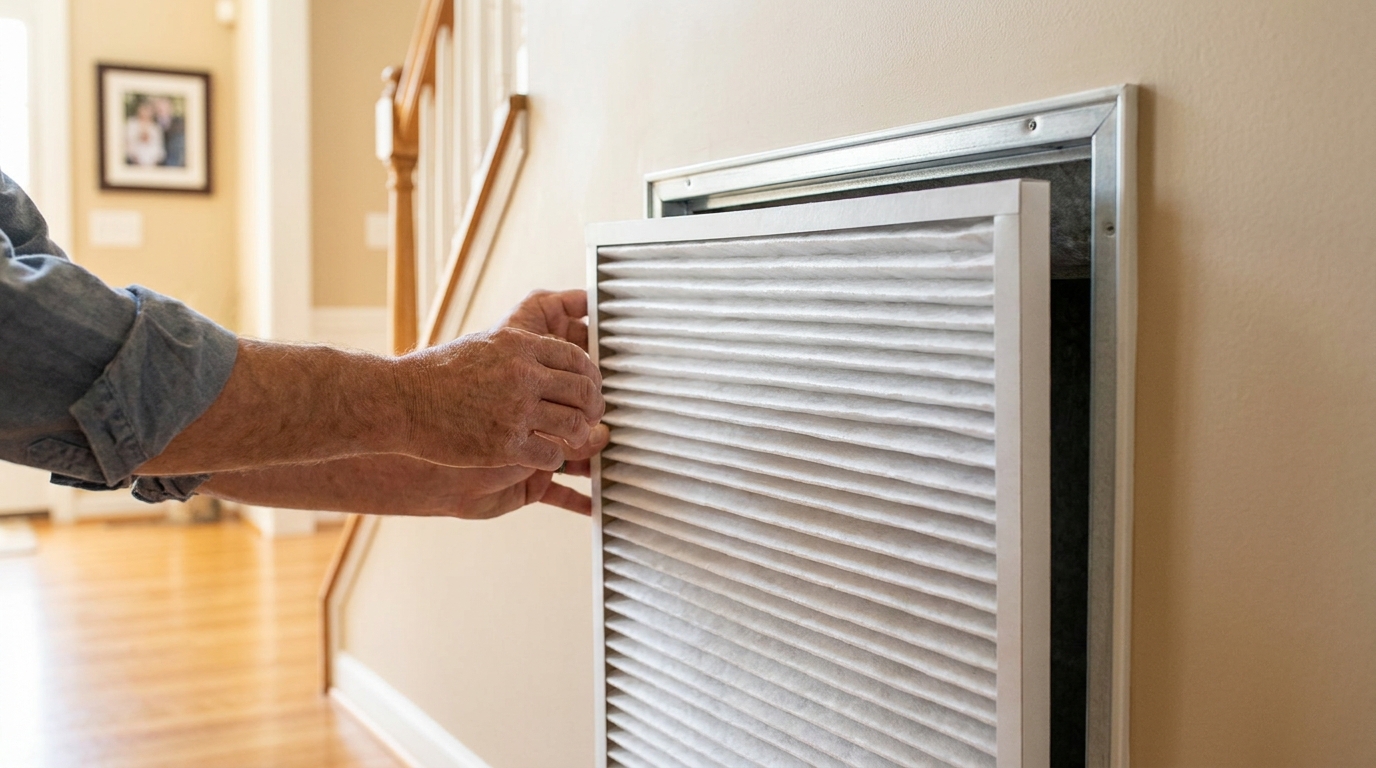
A small confession from the service side of this business: when a tech rolls up on a "the air just isn't moving like it used to" call, the first thing he does is pull the filter. And more often than you'd think, that's the entire visit. Filter out, filter in, invoice for a service call that didn't need to happen.
So let's save you the trip. How often to change your air filter isn't a trick question, but the answer everybody repeats — every 30 days — is wrong often enough to be worth unpacking. Sometimes it's too often. Frequently it's not nearly often enough.
The real answer comes down to three things: how thick the filter is, what's living in your house, and the fact that you live in Alabama. That last one matters more than most homeowners expect.
Start with thickness, because almost nobody checks it
Look at the cardboard edge of your filter. You'll see three numbers — something like 20x25x1. That last number is the depth in inches, and it's the single biggest factor in how long the filter lasts. A 1-inch filter and a 4-inch filter are not the same product doing the same job on different schedules. The 4-inch has vastly more surface area folded into those pleats, so it loads up slower and restricts airflow less as it fills.
| Filter depth | Typical replacement interval | Notes |
|---|---|---|
| 1 inch | 30-60 days | The most common size, and the one that genuinely does need frequent attention |
| 2 inch | 60-90 days | Noticeably more forgiving than a 1-inch |
| 4 inch | 6-9 months | Usually sits in a dedicated media cabinet at the air handler |
| 5 inch | 9-12 months | Same idea, more media. Check it at 6 months anyway |
Those are baselines for an average home with average air. Now start adjusting.
What shortens the interval
- Pets. One shedding dog or cat roughly halves the life of a 1-inch filter. Two or more and you're checking monthly, no argument.
- Allergies or asthma in the house. Not because the filter wears out faster, but because a partially loaded filter stops pulling the fine particles you actually care about.
- Anyone who smokes indoors. Halve it again.
- Recent renovation. Drywall dust is brutal on filters — it's fine enough to pack the media solid. Change it during the work and again when the work is done.
- Running the fan in ON instead of AUTO. Continuous circulation means continuous filtering, which is great for even temperatures and hard on filter life.
And one thing that lengthens it: an empty house. If you travel for six weeks in the fall, the filter doesn't age much while you're gone.
Why central Alabama is its own case
Here's the part the national how-to articles skip. Two things make our filters work harder than the ones in Ohio.
The first is runtime. A Birmingham system runs cooling from roughly April into October, and then turns around and runs heat through the winter. That's a lot of hours of air being pulled through one piece of pleated paper. A system that runs more hours loads its filter faster — the math isn't complicated.
The second is pollen, and we get it twice. Everybody braces for the yellow tree pollen in spring. Fewer people plan for ragweed, which runs from roughly mid-August through the first hard freeze and is, in my experience, the season that catches homeowners off guard. If you're reading this in September and can't remember when you last swapped the filter, that's your answer right there. Go look. We wrote more about the seasonal side of this in our piece on what your HVAC system can do about fall allergies.
A practical habit that works better than a calendar reminder: check the filter on the first of every month, hold it up to a light, and replace it when you can no longer see light through the pleats. Takes ten seconds. You'll change some filters at 45 days and some at 75, which is closer to correct than any fixed schedule.
What a clogged filter actually does to your system
This is where it stops being a housekeeping item and starts being a repair bill. A loaded filter restricts airflow across the whole system, and every downstream problem traces back to that.
In cooling season, restricted airflow means not enough warm air moving across the evaporator coil. The coil gets too cold, condensation on it freezes, and now you've got a block of ice where your heat transfer is supposed to happen. The symptom homeowners report is "it's running constantly but the house isn't cooling" — which sounds like a refrigerant problem and often isn't. It's a $12 filter.
In heating season the failure mode is different and worse. Restricted airflow over a furnace heat exchanger lets heat build up where it shouldn't. Best case the limit switch trips and the furnace short-cycles. Worst case, over years, you stress-crack a heat exchanger, and that's a component replacement or a whole new furnace.
Then there's the blower motor, which just works harder against the restriction, drawing more power and wearing faster. None of this happens overnight. That's exactly why it's easy to ignore.
One myth worth killing: a dirty filter does not clean your air better. The idea that a loaded filter "catches more" gets repeated a lot and it's backwards. Once media is packed, air takes the path of least resistance — around the filter through gaps in the housing, not through it.
Which way does the arrow point?
Every filter has an arrow printed on the frame, and it should point toward the furnace or air handler — in the direction the air is traveling. Air moves from your house, into the return duct, through the filter, into the equipment. So the arrow points away from you and toward the unit.
If your filter sits in a wall or ceiling return grille, the arrow points into the wall. If it sits at the air handler in a closet or attic, the arrow points into the cabinet. Install it backwards and it still filters, mostly, but the wire mesh backing that's supposed to support the pleats is now on the wrong side, and the media collapses toward the blower as it loads.
Don't just buy the highest MERV number
MERV measures how small a particle a filter catches. Higher number, finer filtration — and more resistance. A MERV 13 filter in a system designed around a MERV 8 can starve the blower and cause exactly the airflow problems described above, while you feel good about buying the premium one.
For most Alabama homes, MERV 8 to 11 is the practical band. Go higher only if you know the system's static pressure can handle it, which is something a tech can measure in a few minutes during a tune-up.
When the filter isn't the problem
Change the filter first. Always. It's cheap and it rules out the most common cause. But if you've got a fresh filter and the house still isn't comfortable, the filter has done its job of eliminating itself as a suspect, and the next questions are about refrigerant charge, duct leakage, coil condition, or humidity. That last one is its own subject — we went deep on it in what indoor humidity should be in your Alabama home.
Filter changes are homeowner work. The rest of it isn't, and a filter change doesn't substitute for actual maintenance — here's how often your system should actually be serviced.
Not sure what size or MERV your system should be running? Schedule a tune-up with Ethridge HVAC or call (205) 509-4545. We'll measure static pressure, tell you the right filter spec for your equipment, and check whether anything upstream of the filter needs attention. We serve Birmingham, Trussville, Vestavia Hills, Hoover, and the surrounding communities.